
Passkeys Pay Off: 4 Business Wins SaaS Leaders Can Capture in 2025
Imagine this: while you read the next 30 seconds of copy, your company will silently burn another $70 resetting a forgotten password—the going rate Forrester pegs for a single help-desk ticket.
Multiply that by the 40% of all IT calls that Gartner says are password-related, and you're looking at a seven-figure leak that never appears on the P&L but drags ARR just the same.
Now layer in the $4.88 million average price tag of a breach — IBM's 2024 benchmark, its highest on record—and the case for killing typed secrets writes itself. That's why regulators are asking for "phishing-resistant MFA," attackers are shifting credential-stuffing bots to softer targets, and Google users have already triggered a passkey more than a billion times.
In other words, the workforce is sprinting toward passwordless even faster than Gartner's forecast that over half of all employee logins will drop passwords by 2026.
Executive-summary TL;DR
Passkeys aren't just kinder to users, they're cheaper, faster, and safer for the business. Companies that ship a device-bound login see 98% sign-in success , slash password-reset tickets that average US $70 each , and hit looming mandates for phishing-resistant multi-factor authentication. SaaS teams that move first can reclaim revenue lost to drop-offs and support overhead.
1 | Cut help-desk spend by 55%
Enterprise password resets represent a significant yet often overlooked drain on IT resources and operational budgets.
- The average enterprise resets between 60 and 180 passwords per employee per year, at roughly US $70 per ticket.
- After Microsoft's internal roll-out, password-related help-desk calls fell by 90% .
- Annualised saving for a 1,000-seat SaaS: ~US $3.7M.
What can your organization do? Run a 30-day A/B test—half your staff on passkeys, half on passwords—and track ticket volumes in Jira/ServiceNow.
2 | Lift sign-in conversion to 98%
"I forgot my password" shouldn't be the last words you hear from potential customers. Yet for many SaaS platforms, login friction is a silent conversion killer.

- Google users trigger passkeys 4× faster than passwords and OTPs combined.
- Air New Zealand saw a 50% drop in login abandonment within 24h of launch.
What can your organization do? Surface "Create passkey" immediately after a successful password login; Corbado data shows 88% opt-in when it's the default.
3 | Block 99.9% of phishing and credential stuffing
Enterprise security research consistently shows that despite comprehensive training programs, employees remain vulnerable to sophisticated phishing attempts. Passkeys solve this fundamental security challenge.
- Okta's 2025 threat-intel review found that the most-targeted enterprises default to phishing-resistant factors such as passkeys (Okta).
- Passkeys obey U.S. Executive Order 14028 and Canada's draft Consumer Privacy Protection Act recommendations for phishing-resistant MFA (The White House).
- Security testing demonstrates that passkey-protected admin portals remain secure even when attackers have direct access to a user's email account.
What can your organization do? Map high-risk apps (SaaS admin portals, customer-data stores) and enforce passkey-only sign-ins first.
4 | Future-proof against MFA fatigue & regulations
Compliance requirements for authentication security continue to tighten across industries. Organizations implementing passkeys now position themselves ahead of regulatory mandates.
- The UK government plans to "turn off passwords" across citizen services by 2025 (TechRadar).
- Gartner forecasts 50% of workforce logins will be passwordless by 2026 (up from 10% in 2022).
- Early movers like GitHub have been passkey-ready since 2023 (The GitHub Blog).
- Multiple enterprises report that passkey implementation directly helps satisfy their vendor security requirements.
What can your organization do? Add passkey support to your customer-facing apps this quarter; advertise the upgrade in release notes for competitive halo.
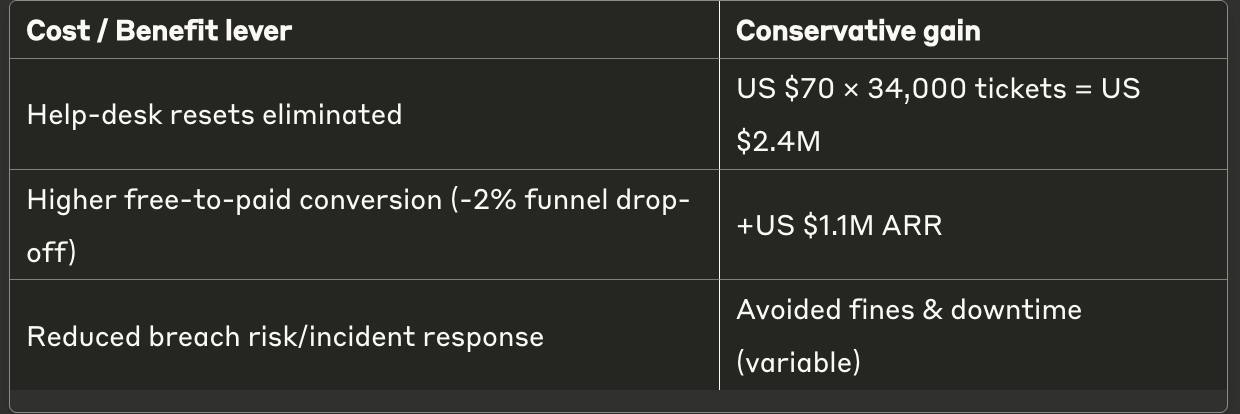
ROI snapshot (12-month horizon)
Financial analysis from early adopters demonstrates clear ROI for passkey implementation across multiple metrics.
Real-world transformation: Canadian implementation considerations
For Canadian SaaS providers, passkey implementation provides a strategic advantage in meeting emerging privacy regulations.
When the Digital Charter Implementation Act started moving forward, forward-thinking organizations recognized that passkeys would position them perfectly for compliance.
Implementation typically follows a straightforward path: integration with the FIDO2 protocol via existing identity providers, followed by staged rollout phases. While comprehensive Canadian adoption data is still emerging, Google's 2023 data showed over 69% of users opted to create a passkey when prompted, with enterprise environments showing particularly strong acceptance due to their enhanced security mandates.
What to do next: 90-day implementation roadmap
Industry leaders have shared a consistent implementation blueprint for passkey adoption:
Enterprise implementation specialists recommend a phased approach for passkey adoption:
- Phase 1 (Week 0-2): Enable passkeys for internal use following Microsoft's testing framework.
- Phase 2 (Week 3-6): A/B test passkey adoption with a segment of customers following Apple's implementation guidelines.
- Phase 3 (Week 7-12): Implement cross-platform synchronization using Google's recommended patterns.
- Phase 4 (Week 13): Publish technical implementation details and benefits in release notes.
The competitive edge businesses can't ignore
Organizations implementing passkeys aren't just deploying a security feature—they're removing an entire category of user frustration from the customer experience.
For SaaS leaders still evaluating passkeys: competitors are already moving. The question isn't whether customers will use passwordless authentication, but whether they'll use it with your platform or a competitor's.
The business case couldn't be clearer. Passkeys deliver the rare trifecta of better security, lower costs, and higher conversion rates. In a market where every point of friction matters and every dollar of CAC needs to count, can any organization really afford to leave this advantage on the table?
Post a comment